Anaplan is an enterprise planning platform that supports budgeting, forecasting, and scenario planning. Finance teams use it to build models that connect key drivers, run what-if scenarios, and coordinate planning inputs across the organization.
The platform is typically used in planning cycles where multiple departments contribute inputs that finance consolidates into a company-wide plan.
Anaplan supports connected planning and scenario modeling at enterprise scale. On G2, users say it brings planning workflows together and helps teams run scenario analysis across the business.
But teams run into limits once they start implementing and maintaining it.
One G2 reviewer says Anaplan requires high costs and strong expertise to implement and manage, and complex models need ongoing support for day-to-day maintenance. Another reviewer says the cost becomes challenging over time and has seen organizations leave Anaplan due to pricing.
Users also flag friction around integrations and reporting. A G2 reviewer says the integration still feels challenging, and improvements may come at an added cost. Another reviewer says reporting constraints push teams to export data to other tools to get the analysis they need.
These concerns also surface in Reddit discussions. In r/FPandA, one finance leader shared that after starting down the Anaplan path, they learned they would “need at least one person working practically full-time to maintain and update the models,” highlighting the ongoing resource commitment some teams experience.
For some teams, these trade-offs prompt a search for alternatives that are easier to implement, require less ongoing maintenance, and offer more predictable pricing. Many organizations prioritize flexibility, faster time-to-value, and tools that do not require dedicated administrators to manage day-to-day.
The best Anaplan alternatives help FP&A teams turn inputs into faster forecasts, clearer scenarios, and more usable reporting, without adding extra overhead. We chose these companies based on planning depth (forecasting, driver-based modeling, scenarios), reporting and analysis workflows, integration strength across core systems and spreadsheets, control features like permissions and audit trails, and proven adoption across mid-market and enterprise finance teams.
Cube is the financial intelligence platform built for the AI-era. It elevates how FP&A teams plan, analyze, and drive decisions by replacing manual work with automation and intelligence that unifies data from every source system into one governed, real-time source of truth.
Its patented technology lets teams work seamlessly across Excel, Google Sheets, dashboards, and chat with full lineage and auditability. With AI-driven forecasting, automated variance analysis, and conversational insights, Cube transforms workflows to deliver faster closes, stronger forecasts, and finance teams focused on insight, not reconciliation.
Many companies (like Edge Fitness Clubs and BlueWind Medical) use Cube for nearly all of their financial operations.
Key Features:
Pros:
Cons:
Customer review ratings: Capterra: 4.6/5
Pricing: Cube stars at $30,000 annually , with custom plans to fit the specific needs of your organization
Cube and Anaplan can both support planning, forecasting, and scenario work, but they fit different FP&A operating styles. Anaplan often aligns with enterprise teams that can absorb a longer rollout and heavier ongoing model management.
Cube focuses on helping FP&A teams plan and report inside the spreadsheets they already rely on, with native Excel and Google Sheets support, faster onboarding, simpler administration, and reporting that stays fully customizable in a familiar workflow. If your team wants to keep current models, move faster on ad hoc analysis, and update planning logic without leaning on consultants, Cube typically comes out ahead.
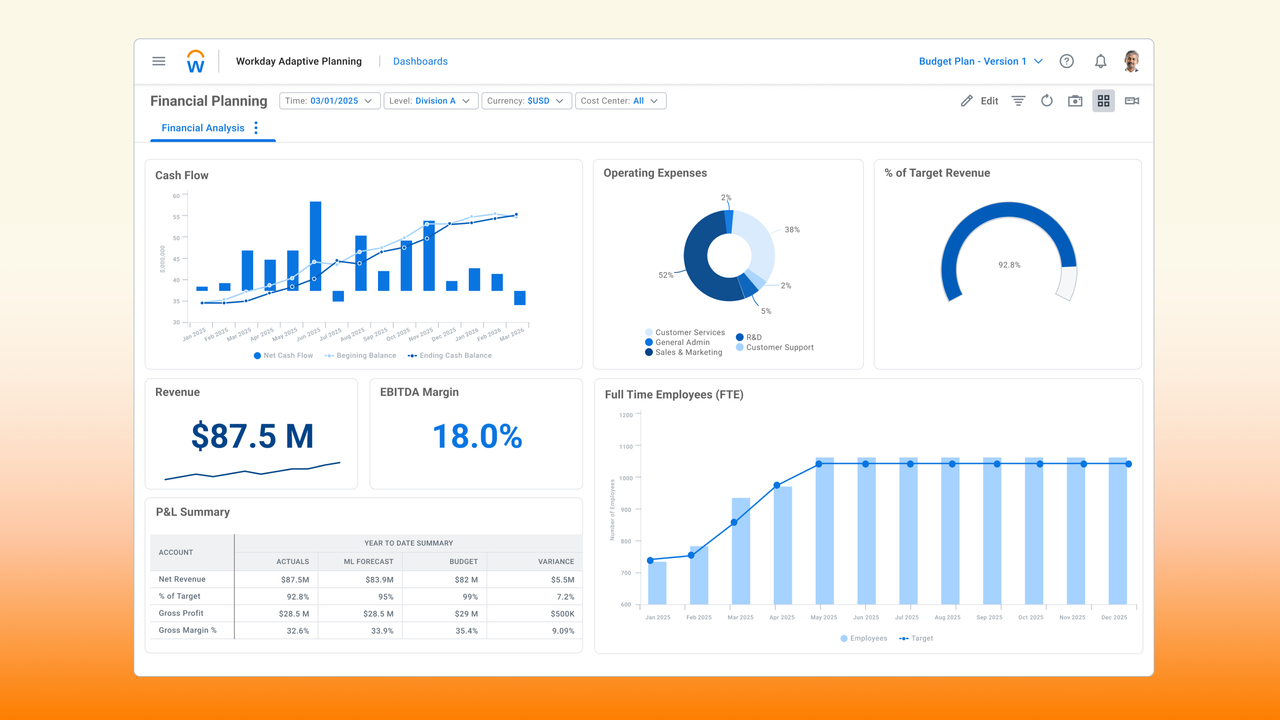
Workday Adaptive Planning is an enterprise performance management software offering collaborative financial tools for sales, finance, and workforce planning. The software enables users to prepare cash flows, manage expenses and revenue, model the workforce, manage capital, perform financial close, and more.
However, its enterprise focus makes it better suited to larger companies seeking an FP&A overhaul. Adaptive’s pricing packages might also be too much for small businesses.
Key Features:
Pros:
Cons:
Customer review ratings: G2: 4.3/5
Pricing: Workday Adaptive Planning does not make any pricing plans public. They offer free trials and demos of their software and will work out a custom quote if you reach out to their team.
Also read: Anaplan vs. Adaptive vs. Planful vs. Vena vs. Datarails vs. Cube
Planful is a cloud-based financial performance management platform that supports budgeting, forecasting, reporting, and financial close activities in one system. It lets teams build plans and scenarios, consolidate and reconcile close data, and use dashboards and analytics to review performance, with integrations that pull data in and keep models updated.
Key Features:
Pros:
Cons:
Customer review ratings: Capterra: 4.3/5
Pricing: Planful doesn’t make any pricing plan public. You’ll need to reach out to their sales team for a quote.
IBM Planning & Analytics is an FP&A planning platform that supports budgeting, forecasting, variance analysis, and scenario modeling in a governed environment powered by the IBM TM1 database. It brings planning into a single model so teams can run what-if scenarios, update forecasts with real-time calculations, and keep income statements, balance sheets, and cash flow planning aligned. It also supports work in Excel or a web interface, includes write-back workflows, and offers integration.
Key Features:
Pros:
Cons:
Customer review ratings: G2: 4.4/5
Pricing: Starts at around $875/month
Oracle Fusion Cloud Enterprise Performance Management (EPM) is a cloud-based platform that supports financial planning, consolidation, close, and enterprise data management in a single environment. It combines planning, forecasting, profitability analysis, and reporting workflows on a shared data model with centralized governance.
The platform supports scenario modeling, long-range planning, budgeting, and rolling forecasts, while also covering financial close, account reconciliation, tax reporting, and narrative reporting. The platform helps teams coordinate planning cycles, manage complex structures, and maintain auditability across finance and adjacent planning processes.
Key Features:
Pros:
Cons:
Customer review ratings: G2: 4/5
Pricing: Pricing isn’t listed on its website
Finmark is a financial modeling software built for startups and SMBs that focuses on budgeting, scenario testing, and planning workflows designed to reduce manual spreadsheet work. The product was acquired by BILL in November 2022, and Finmark has announced the original Finmark product will be sunset, with availability ending April 1, 2026. Following the acquisition, Finmark’s financial planning and cash flow modeling capabilities were integrated into BILL’s financial automation platform for SMBs. BILL positions itself as an all-in-one financial operations platform, combining payables, receivables, expense management, and now planning tools to give small and midsize businesses more comprehensive, real-time cash flow visibility.
Key Features:
Pros
Cons:
Customer review ratings: G2: 4.6/5
Pricing: Pricing not listed on its website
ClicData is a cloud-based data analytics and business intelligence platform that supports data integration, modeling, analysis, and visualization in a single environment. It combines data consolidation, analytics workflows, and dashboarding to help teams work with structured and unstructured data without moving it across separate systems.
The platform includes built-in tools for preparing data, running statistical analysis, and producing reports and dashboards that update as underlying data changes. ClicData supports Python and SQL-based analysis alongside no-code exploration tools, allowing teams to run forecasts, test assumptions, and analyze trends directly on centralized data.
Key Features:
Pros:
Cons:
Customer review ratings: G2: 4.4/5
Pricing:
Jedox is a planning and performance management platform that supports budgeting, forecasting, reporting, and consolidation in a centralized environment. It combines a web-based planning experience with an Excel add-in so teams can work in spreadsheets while writing back to a governed model, with controls for versions, permissions, and auditability.
It also supports connected planning across financial and operational inputs by linking data from core systems into a single model, then using workflows and automation to reduce manual rollups and repeated spreadsheet cycles.
Key Features:
Pros:
Cons:
Customer review ratings: G2: 4.3/5
Pricing: Pricing isn’t listed on its website
Vena is an FP&A platform built around Excel that supports planning, forecasting, reporting, and financial close workflows. It centralizes financial and operational data in a controlled database while allowing teams to model, analyze, and report directly within familiar spreadsheet environments. Vena integrates with Microsoft 365 and common business systems to support cross-functional planning, scenario analysis, and ongoing performance monitoring across the organization.
Pros:
Cons:
Customer review ratings: G2: 4.3/5
Pricing: Pricing isn’t available on its website
Board combines planning, analytics, and reporting in one enterprise planning platform. It unifies finance, operations, and strategy planning so teams can run budgets and forecasts, test what-if scenarios, and share dashboards that update as data changes. Board supports governed models with audit trails and controls that help teams manage access, approvals, and data integrity across planning cycles.
Key Features:
Pros:
Cons:
Customer review ratings: G2: 4.4/5
Pricing: Pricing isn’t available on its website
Planning Maestro by Centage is a financial planning and analysis platform used for budgeting, forecasting, workforce planning, and scenario modeling. The software connects financial statements, payroll, and operational data into a single model so teams can compare budgets to actuals, evaluate labor-driven costs, and test planning assumptions without relying on spreadsheets.
Key Features:
Pros:
Cons:
Pricing:
Customer review ratings: G2: 4.4/5
Pricing:
Centage has three pricing plans, with pricing starting at $1,750 per month billed annually:
Prophix provides finance teams a single platform for budgeting, planning, reporting, and close management. It combines structured planning models with workflow controls to route reviews and approvals, track changes, and support repeatable planning cycles. The platform includes anomaly detection to surface unusual patterns in financial or operational data, plus dashboard-based data visualization for monitoring performance and investigating variances.
Key Features:
Pros:
Cons:
Customer review ratings: G2: 4.4/5
Pricing:
Pricing is unique to each customer, so no prices are listed online. However, sources report that the total cost of ownership is low.
Oracle Hyperion Planning is a centralized FP&A application that brings financial and operational planning into one environment so teams can build budgets, forecasts, and plans on a shared set of assumptions. It supports multiple deployment options (cloud, on-premises, third-party data center, or hybrid) and pairs a Microsoft Office-based interface with packaged integration approaches to keep plans and reporting aligned.
Key Features:
Pros:
Cons:
Customer review ratings: G2: 3.9/5
Pricing: Customers cite that plans range from $1,000 to $2,500 per month.
Sisense combines data connectivity, modeling, and embedded analytics so teams can turn dashboards into in-app actions. It connects to hundreds of sources, supports cloud deployment, and lets you build with no-code, low-code, or API-first tools depending on how technical your workflow is.
Key Features:
Pros:
Cons:
Customer review ratings: G2: 3.9/5
Pricing: Pricing not listed on its website
15. OneStream
OneStream is an enterprise finance platform that unifies financial and operational data in one system, embeds AI to support analysis and automation, and scales as business needs change. It supports core finance processes such as consolidation, reporting, planning, forecasting, and what-if modeling, helping teams reduce manual data work and run standardized workflows across entities and departments.
Key Features:
Pros:
Cons:
Customer review ratings: Capterra: 4.8/5
Pricing: OneStream does not publicly list product pricing, so you need to contact the vendor for a quote based on your scope and requirements.
16. SAP Analytics Cloud
SAP Analytics Cloud is a platform that combines analytics and planning to support reporting, insight discovery, and business planning across your key business applications and data sources. It uses generative AI with Joule copilot to automate reporting tasks, surface insights, and help teams build plans. It also provides prebuilt, industry-focused content to support business intelligence.
Key Features:
Pros:
Cons:
Customer review ratings: G2: 4.2/5
Pricing:
The best alternative to Anaplan depends on what your team values most. On Reddit, the discussion centers less on replacing Anaplan outright and more on how newer-generation platforms compare in speed, usability, and architecture. Commenters describe planning software in “generations,” with Anaplan viewed as an early-gen platform and newer tools built on modern tech stacks that solve many of the performance and scalability issues finance teams used to face.
On Gartner Peer Insights and other review platforms, the evaluation tends to be more structured but the themes are similar. Buyers compare competitors based on integration and deployment experience, service and support quality, scalability, and day-to-day usability. Platforms like Workday Adaptive Planning, OneStream, Oracle Fusion Cloud EPM, Vena, Prophix, IBM Planning Analytics, Jedox, and Board consistently appear as leading alternatives. Reviewers often highlight improvements in ease of use, dashboard flexibility, Excel integration, and implementation experience compared to legacy systems.
Tools like Vena, Planful, and Pigment frequently come up in Reddit conversations, particularly among mid-market and scaling teams. Cube is often mentioned by finance teams that want to keep Excel or Google Sheets as their working layer while adding automation, cleaner data connections, and AI-driven financial intelligence behind the scenes, without moving to a fully separate modeling environment.
Across Reddit and Gartner reviews, the takeaway is consistent: competitors are increasingly evaluated on speed, ease of adoption, integration depth, and how well they balance powerful modeling with everyday usability.
Anaplan can be an overwhelming solution suited primarily for large, enterprise-level organizations. If your FP&A team doesn’t require complex computational or multi-scenario modeling, you’ll likely benefit more from software with:
Does this sound like what you're looking for? It’s time to try Cube.
Cube is an advanced financial intelligence platform designed for the AI era. It consolidates data from all your systems and spreadsheets to enhance planning, accelerate analysis, and reveal the insights that drive better decisions. Plus, it gives FP&A teams the flexibility to work seamlessly in Excel, Google Sheets, the web, or chat—making it the smartest way to work with the tools you already love.