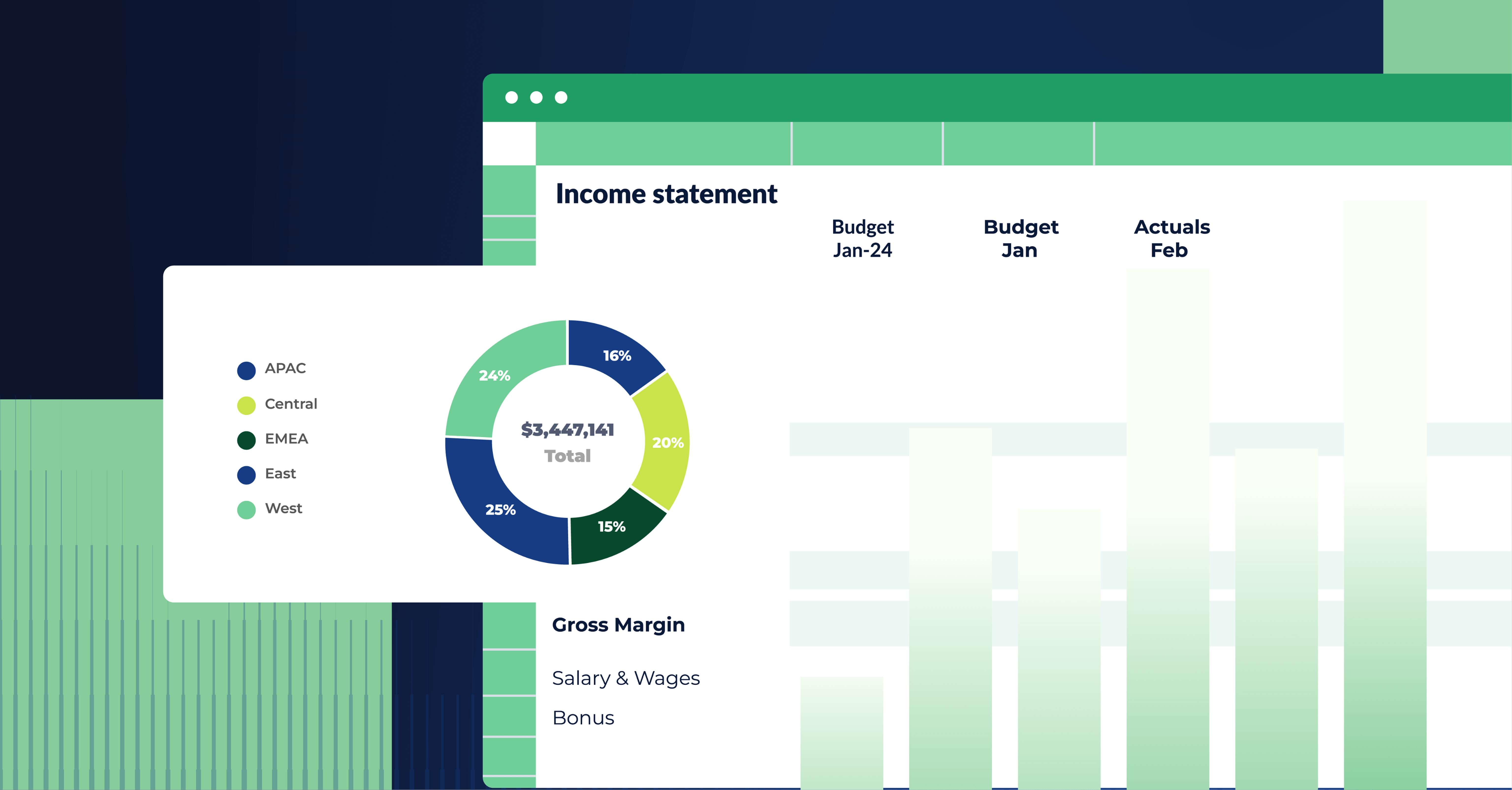
Every business is feeling the pressure of rapid change driven by AI, where critical operational choices from shifting hiring plans to reallocating marketing spend happen in real time. Because finance sits at the intersection of every operational stream, it operates as the ultimate downstream function, naturally capturing and unifying all the context across the entire organization.
Traditionally, finance discovered these shifts weeks later during the monthly close, constrained not by a lack of speed in FP&A, but by the challenges of accessing real-time data and keeping up with rapidly changing operations. Today, finance must move continuously at the speed of AI and modern business, stepping beyond traditional monthly cadences to empower organizations with a proactive operational pace.
For the business, this evolution changes everything. As finance transitions into an active, continuous partner, decision-making becomes grounded in instant financial context, allowing teams to move faster with total confidence. When finance changes, the entire business shifts from reactive management to proactive, finance-driven execution. This post outlines how AI is driving this transformation, what the future holds for finance roles, and how Cube helps businesses thrive in this new landscape.
The business sped up
The business now moves at the speed of AI. Signals process faster, analysis runs continuously, and teams test, learn, and reallocate in shorter cycles. Legacy finance software was built for a different rhythm: close the books, report what happened, update the plan, and repeat. That cadence worked when major decisions occurred quarterly or annually, while top-tier companies managed monthly cycles.
Yet today, businesses cannot simply move quickly; they must operate continuously in real time. Because time is money, reacting after the fact comes at a steep price.
The faster the business moves, the closer finance has to be to the business.
When finance reports after the decision, the business loses the discipline that keeps growth profitable. When finance is in the room while the decision is being made, the business moves faster and stays grounded in financial reality. The faster the business moves, the closer finance has to be to the business. When change is constant, finance has to become continuous.
Continuous planning has been discussed in the office of the CFO for decades, dating back to my time at Deloitte in 2007. However, it has largely remained an elusive goal for companies constrained by data and bandwidth limitations. Today, continuous operation is no longer just a vision; it is an operational necessity. Traditional planning breaks down when teams must shift budgets dynamically in real time to capitalize on new opportunities.
From Financial Planning & Analysis to Financial Partnering & Action
We call this shift Financial Partnering in Action, or FP&Action for short. It builds on traditional FP&A: planning and analysis remain the essential foundation, while partnering and action represent the strategic layer finance adds on top.
Financial intelligence explains what is happening. Operating Intelligence helps the business determine what to do next without losing financial discipline.
For example, consider what that looks like in practice: Forty enterprise implementations are running behind schedule. Contract terms show that $6M of Q3 invoices are tied to those go-lives, so if they slip, $6M of cash collection moves into Q4. CubeOI analyzes the schedule risk, models the cash flow impact, and recommends pulling $500K of Q4 contractor budget into Q3 to keep implementation on track. The CFO reviews the recommended scenario and approves the trade-off. Then contractors get added, go-lives get tracked, and invoices get scheduled. Most finance teams handle the first three steps by hand, usually after the meeting where the decision got made. Financial intelligence covers those three. Operating Intelligence covers all five, and Cube is building toward the last two.
The Finance-Driven Organization
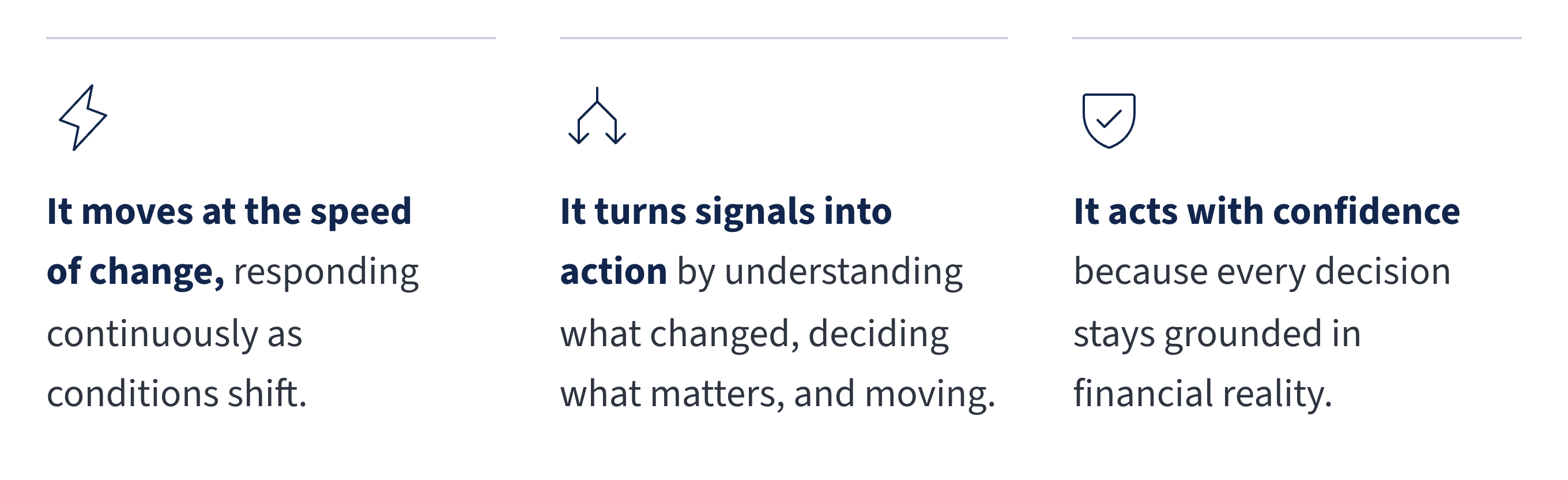
Our vision is to empower every company to become a Finance-Driven Organization—one where rich financial and operational context is seamlessly woven into daily decision-making. As the ultimate downstream function, finance sits uniquely at the crossroads where every decision, initiative, and strategy culminates. This gives finance a complete, unparalleled view of the entire organization. Built upon this rich foundation, the Finance-Driven Organization rests on three core pillars:
Finance cannot achieve this in isolation. Sales pursues the right opportunities, marketing makes strategic investments, the people team builds the org, operations sets priorities, and executives steer the business forward. Every leader needs financial context at the moment of decision, and finance is uniquely positioned to supply it. When the business sees that it operates better with finance guiding the way, the role of the CFO evolves permanently.
Cube Operating Intelligence: the financial brain with all the context
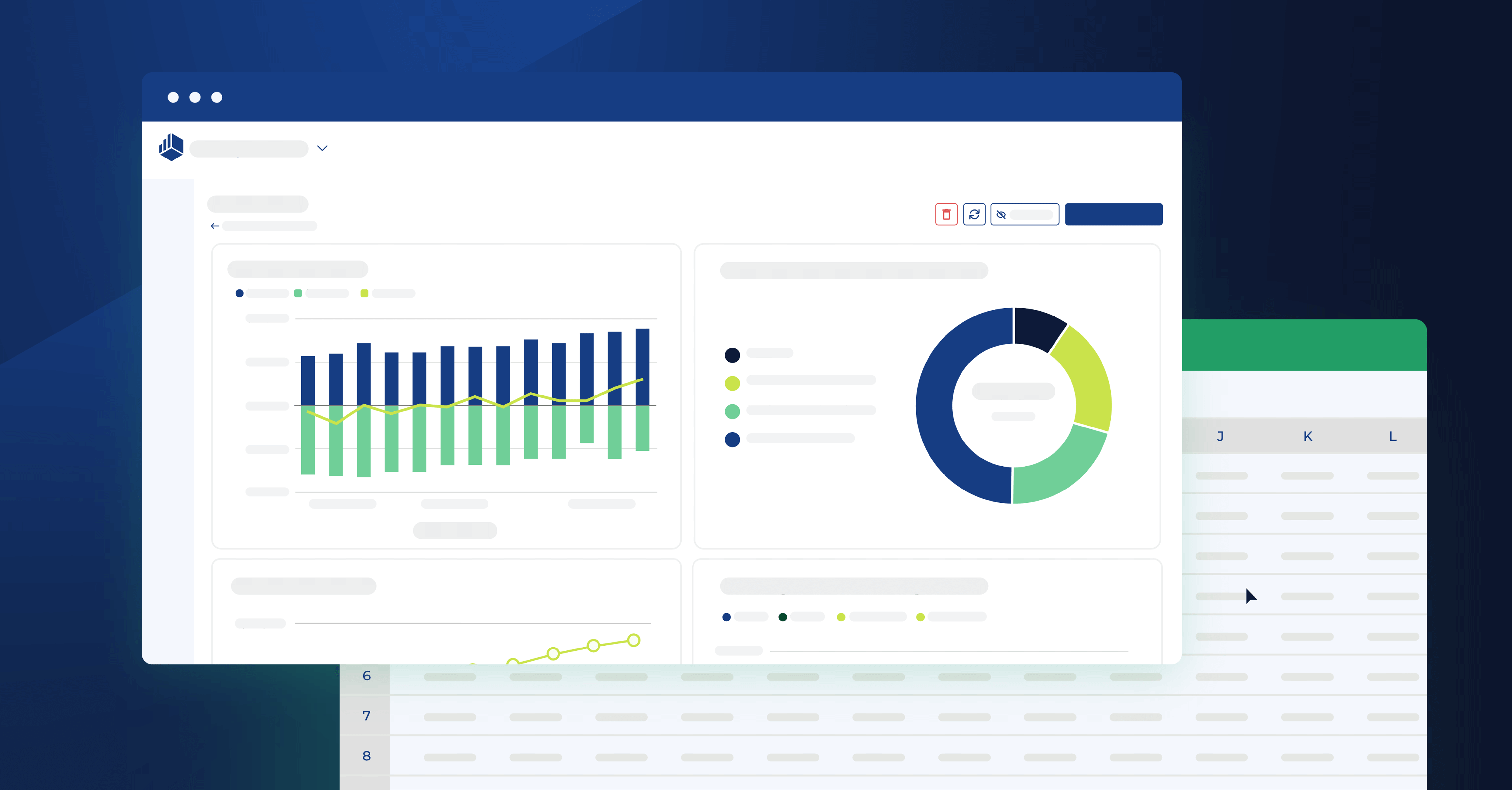
Cube is the agentic FP&A platform that helps finance teams shape what happens next. At its core is Cube Operating Intelligence™ (CubeOI™), the layer that holds the context behind every financial decision.
Context means more than data. Data tells AI what the numbers are. Financial context tells AI what the numbers mean: how they relate, what drives them, and where they came from, and most importantly: who is allowed to see them. CubeOI™ holds that understanding and puts it to work in four ways. It supplies the governed financial and operating context. It reasons from that context to explain what changed, why, and what it means for the plan. It offers guidance in the form of options, scenarios, and tradeoffs that help finance and business leaders decide what to do next. And it is building toward action, where decisions become owners, approvals, and tracked follow-through.
80% accuracy in finance is 100% wrong.
This dynamic also determines trust. While AI can be 80% accurate in many fields, 80% accuracy in finance is 100% wrong. Every answer from CubeOI originates from the governed financial model that finance controls, maintaining complete traceability to source data so leadership can make decisions with complete confidence.
In a recent study conducted by Cube, performance was compared between a finance team using Claude in Excel alone versus a team using the same resources with Cube as a context layer. The study revealed that data accuracy with Claude in Excel alone was only 65%, whereas accuracy with Cube as a context layer reached 100%.
Headless by design: context from everywhere your team works
A brain is only as good as what it can see. The context behind a financial decision rarely lives in one place. Some of it sits in business data, such as contracts, headcount, pipeline, and the ledger. A great deal of it sits in the places where people actually work: the assumptions in a planning spreadsheet, the caveat in a board deck, the reasoning in a Slack thread, the question someone asked an AI assistant last week. We think of that as shadow data, and it is often the part that explains why a number is what it is.
A system that only reads the ledger misses all of it. That is why Cube is headless by design. CubeOI is a governed data and AI layer that deploys alongside the platforms a company already runs, with no single interface required. It connects to Excel and Sheets, PowerPoint and Slides, Slack and Teams, the Cube web app, and the AI assistants teams already use. Wherever your team works, Cube is there, collecting context on the way in and delivering the same financial truth on the way out.
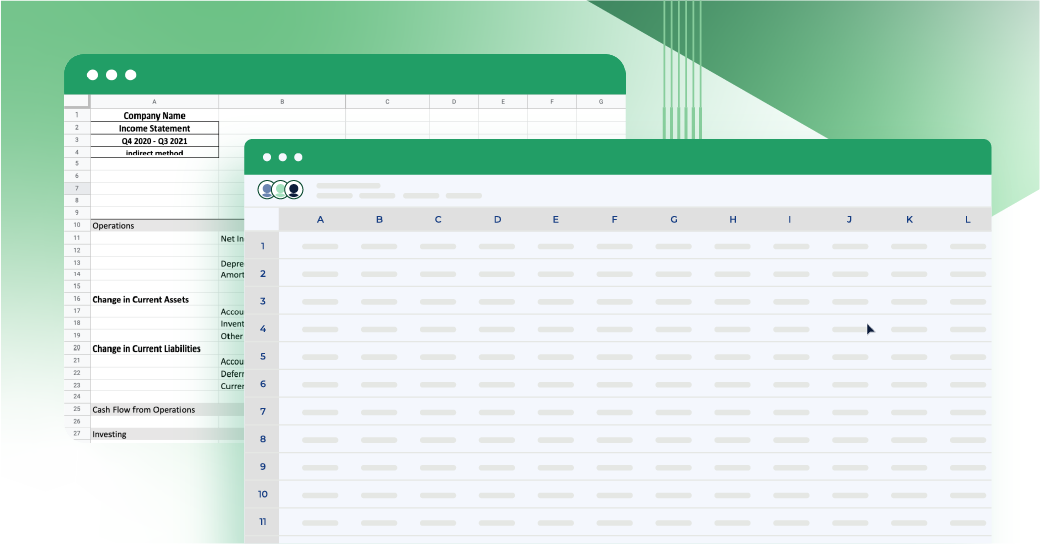
It grew from where we started. I founded Cube as a former CFO who had led finance transformation at a Big Four firm, and I observed behavior that proved a critical point: after decades of vendor attempts to push finance teams into various other software interfaces, finance professionals consistently preferred to stay in the ultimate UI: the spreadsheet. From our founding through 2025, Cube was spreadsheet-native. This meant that teams could get the benefits of our cloud-based FP&A platform but continue to work in their spreadsheets, while Cube delivered the governed context to take unstructured spreadsheets and make them into usable workflows.
As finance work expanded into Powerpoint/Slides, Slack/Teams, and of course AI via MCP, Cube became workflow-native in 2025. Since 2026, Cube has been headless, which makes it the original headless FP&A solution. Any surface, one financial truth.

The Digital Finance Team: always on, finance in control
Real-time only works if your team is working at all times—which in most cases isn't plausible or ideal. That is where Cube's always-on Digital Finance Team and FP&A agents come in to handle work around the clock. At 2:14 AM, agents flag spend running 12% over plan and draft three scenarios. At 9:05 AM, the CFO picks one, and owners are notified automatically.
Agents monitor, analyze, model, investigate, and coordinate. People judge, prioritize, decide, partner, and lead. Agents do the work, and finance sets the rules. As agents take on more of the work, control matters more, so Cube gives finance direct ownership of the model, the planning process, and the rules the agents follow, with no-code tools and no waiting on an engineer or a consultant.
The Trap of Building In-House
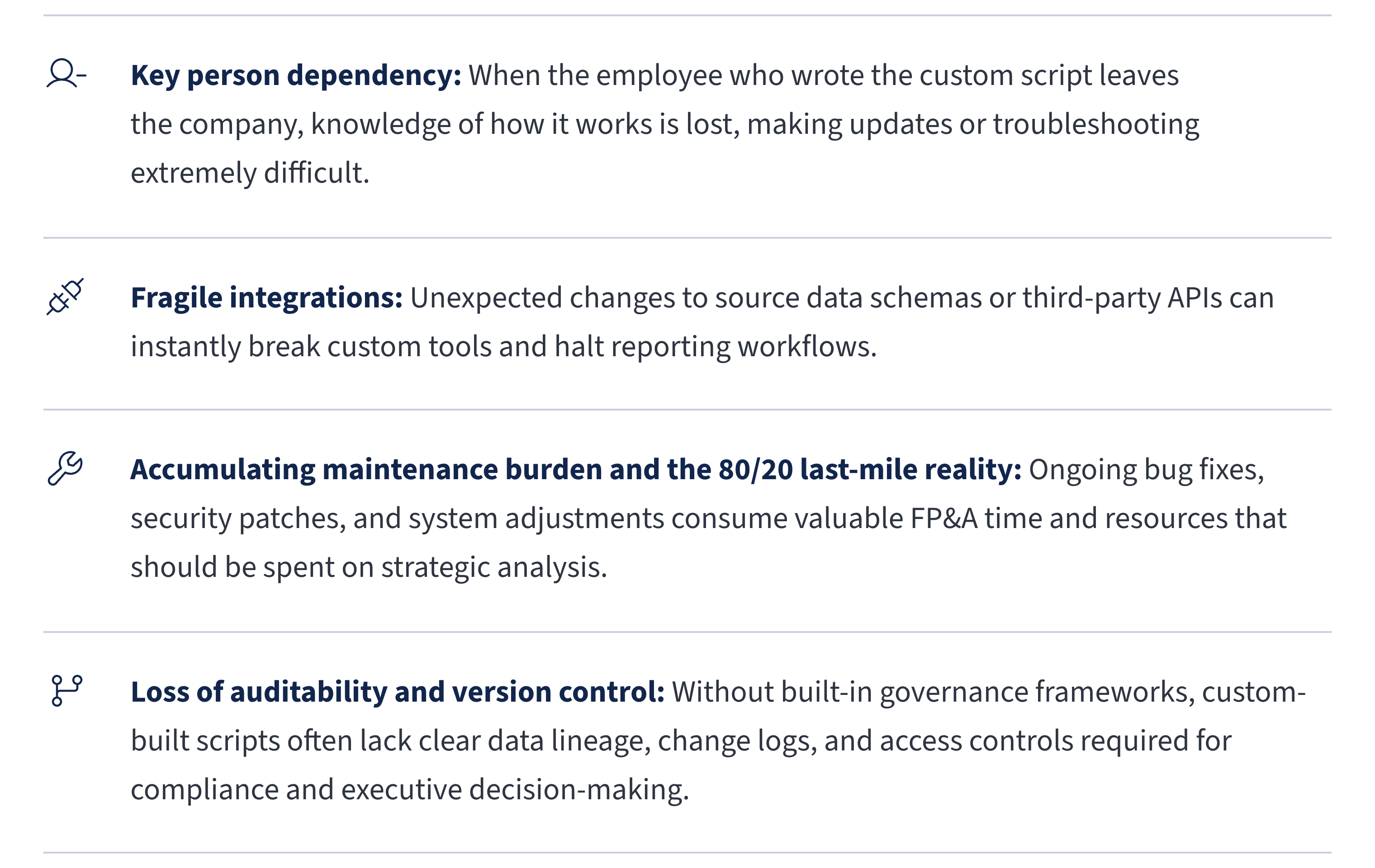
In an era where quick AI scripting makes internal tool development seem easy, some finance teams attempt to build custom scripts to connect disparate FP&A data sources. Driven by ambitious goals, teams often believe they are crafting a custom operational engine tailored to their workflows. However, what begins as a simple solution quickly breaks down under operational realities. In-house builds lack the deep financial context, rigorous controls, and governed architecture required to maintain trusted insights as the organization scales.
Drafting an ambitious custom script or building a dashboard is like drawing a simple blueprint: it quickly visualizes the goal, but it won't withstand real-world pressure. In finance, precision is non-negotiable: an AI solution that works most of the time is unusable when compliance, board reporting, and capital allocations are on the line. In a recent study conducted by Cube, performance was compared between a finance team using Claude in Excel alone versus a team using the same resources with Cube as a context layer. The study revealed that data accuracy with Claude in Excel alone was only 65%, whereas accuracy with Cube as a context layer reached 100%.
Moving from a rough prototype to a load-bearing foundation requires strict data governance, absolute auditability, and reliable control frameworks. Partnering with a dedicated platform like Cube ensures that every insight is backed by full lineage and deep financial intelligence, giving leadership the trust and certainty required to act decisively.
 Where we stand
We stand at the defining inflection point in the history of corporate finance. For decades, finance has been relegated to the backseat, expected only to record history, enforce budgets, and report on decisions already made. That era is over. We believe that finance must own its destiny, trust its intelligence, and operate natively where teams already work. Operating Intelligence is not an incremental feature or a temporary trend; it is the fundamental architecture of modern business leadership.
The future of business will not belong to those who merely report on change, but to those who drive it. The future of business is finance-driven, and Cube is building the engine that powers it. We invite forward-thinking finance leaders to join us in leading this transformation: navigating uncertainty with conviction, grounding real-time strategy in unassailable truth, and defining the next era of business.
Welcome to the age of continuous intelligence: where finance no longer merely keeps the score, but authors the victory.