Two jobs, one foundation
The switch to FP&A starts as a change in the question you are paid to answer. The close asks whether a number is correct. FP&A asks what that number means for the plan, and what to do about it. Everything else follows from that single reframe.
It helps to see the two jobs side by side. They are not in competition, and one is not more important than the other. They point in opposite directions in time, and they are measured by different things.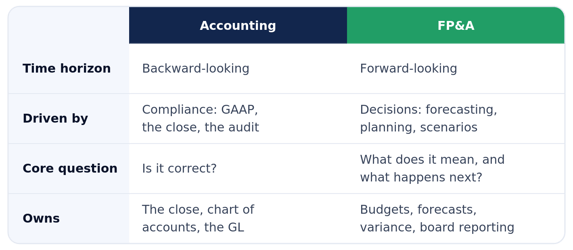 Read that table and the anxiety usually eases, because you realize you are not starting from zero. A large part of FP&A rests on habits you already practice every month. Sort the work into three buckets and your head start becomes obvious.
On one side sits accounting-only work: transaction recording, journal entries, and audit-trail integrity. That stays with the close. On the other side sits the new muscle you will build: assumptions and drivers, forward scenarios, and narratives that cross departments. In the middle, shared by both jobs, is a foundation you live in every day: GL fluency, the chart of accounts, month-end discipline, and a standard for data accuracy that most of the business does not even know it depends on.
That middle bucket is why an accountant can step into FP&A and be good at it quickly. The reconciliation instinct that keeps your close clean is the same instinct that makes a forecast trustworthy. So do not try to learn FP&A as a brand-new discipline. Learn it as your existing discipline pointed forward.
Accounting asks whether a number is correct. FP&A asks what it means, and what happens next.
Why FP&A earns its seat
Before the how, the why, because you will be asked to justify the time. Accounting keeps the record accurate. FP&A connects that record to the decisions leadership has to make. Without it, a company runs on numbers that are correct but late, and late numbers cost real money.
The clearest way to picture the function is as three layers.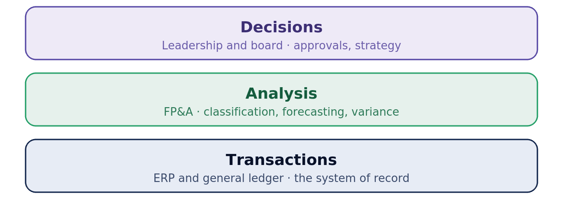 Transactions sit at the base: the ERP and general ledger, the system of record. Analysis sits in the middle: the FP&A layer that classifies, forecasts, and explains. Decisions sit at the top: the budget approvals and strategic calls leadership makes every quarter. Accounting keeps the base accurate. FP&A is the connective tissue that carries it upward. That connection is the entire job, and it is now yours to run.
When the middle layer is missing, the gaps do not stay hidden. They surface fast, and they surface as the kind of surprise no one wanted.
-
Cash surprises. Burn is discovered too late to act on. By the time it is visible in the actuals, the runway is already shorter than the plan assumed, and the options for fixing it have narrowed.
-
Missed hiring plans. Headcount gets approved without a funded plan behind it. The gap does not show up in the offer letter. It shows up mid-quarter, when the spend is already committed.
-
Board confidence. Manual, error-prone decks quietly erode the board's trust in finance. And lost trust does not invite less scrutiny. It invites more.
None of these are exotic risks. They are the failures every under-resourced finance function eventually hits, and each one is expensive enough to justify the role on its own.
Keep the ERP as the source of truth
Before you build a single forecast, adopt the one principle that governs all of it: never duplicate or override the ERP. The general ledger stays the system of record for transactions. Everything downstream enriches and reclassifies that truth into a view leadership can decide from.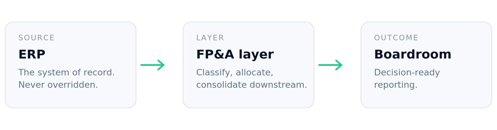 This will feel natural, because it is the same discipline that keeps your close defensible. You do not retype the ledger into a new tool and start editing it. You carry it forward and add structure on top: the classification, allocation, and consolidation logic that turns raw transactions into a decision-ready read.
Hold to this and two problems disappear before they start. Your numbers never drift from the source, because the source is never copied. And when the ERP changes, your reporting survives it, because the reporting was built as a layer on top rather than a fragile duplicate sitting beside it.
Plan, forecast, and explain
FP&A is a set of recurring processes, not a one-time project. Six workflows now sit on your desk: budgeting and annual planning, rolling forecasts, variance analysis, multi-entity consolidated reporting, board and investor packages, and the mechanics of headcount, multi-currency, and allocations. Learn the rhythm of the first few and the rest fall into place around them. Start with the three that run on a monthly loop.
The annual budget sets the plan for the year, by department. The rolling forecast updates that plan monthly or quarterly against actuals. The discipline that makes both work is keeping them on the same model as your actuals, so the plan and reality never live in separate spreadsheets that someone has to stitch together the night before a board meeting. A budget keeps spending aligned to the business. A rolling forecast turns a static snapshot into a moving picture, and it flags a cash runway problem early, while there is still time to act.
Then comes the part where you actually add value: variance analysis. Computing the gap between actuals and plan is the easy step. The value is in the explanation. A good variance note answers three questions, in order.
-
What moved, and by how much? Name the line and the exact size of the gap against plan. Precise, not directional. "Sales opex was 340K over plan," not "sales was up."
-
Why did it move? Was it a timing difference, a one-off item, a missed assumption, or a real trend shift? Each of those demands a different response, so naming the true driver is the whole game.
-
Does it change the forecast? This is the point of the note. If the driver is a one-time event, you leave the forecast alone and say so. If the driver persists, it feeds straight into the next forecast update and into the board commentary.
Work through a real example and the pattern is clear. Marketing lands 40K over plan. The gap is timing on a campaign that will now hit next quarter, so the annual number is unchanged and no one needs to worry. R&D lands 150K under plan because two roles stayed open, so you lower the forecast and flag the hiring risk. Same size of variance, opposite implications, and the only thing that separates a useful note from a confusing one is the explanation.
Field note: A variance explanation without a forward-looking implication is a history lesson, not finance leadership. Always close the note with what it means for the next forecast.
Report to the board
Board reporting feels high-stakes because the audience is, but the artifact itself is repeatable. It is the same set of views each cycle, refreshed with new numbers. A typical package answers five questions in sequence: how did the period land (the P and L summary), where did reality diverge from the plan (budget versus actual), how long can the current burn run (cash position and runway), what do the operating metrics say (the KPI dashboard), and what does the outlook look like now (the forward view). Build the template once and every cycle becomes an update instead of a rebuild.
If the company runs more than one entity, one more step comes first. Consolidation has to happen before any group-level number is safe to present, and three things have to be handled consistently every period: currency converted on the same rules across entities, intercompany transactions eliminated so the group is not counting itself twice, and entity-level data rolled up into a single consolidated view. Skip any one of them and the board is looking at a confident number that does not mean what it appears to.
Running it without drowning
The processes above are the job. The real question, especially on a lean team, is how to run them at a sustainable pace without a weekend of copy-paste before every deadline. Three shifts do most of the work.
First, automate the data plumbing. Connect your source systems once, define how accounts roll up once, and build each metric once. After that the data flows on its own, reports refresh as new data lands, and a chart-of-accounts change no longer means rebuilding every report by hand.
Second, make reporting a refresh, not a rebuild. Build a report a single time, in the spreadsheet or on the web, formatted the way your stakeholders expect it. Then refresh it for each new period with one click, and let the board visuals redraw from live data instead of being rebuilt chart by chart. Board prep goes from days to minutes, and it is always tied to the latest actuals.
Third, plan in scenarios, not a single number. Leadership rarely wants one forecast. They want to see the range. Model a base, an upside, and a downside as separate scenarios, run as many passes as you need without touching your baseline, and keep the whole thing honest by pushing each period's actuals into the forecast as the period closes. Presented well, scenarios turn a single guess into a set of choices leadership can weigh. The purpose of a forecast is not to be right. It is to be useful.
Where Cube fits: This is what Cube, the Agentic Finance Layer, is built to do. Bi-directional connectivity keeps a single source of truth in sync with your source systems, reports refresh as new data lands, and mappings survive an ERP change without a rebuild. You keep working in the spreadsheet you already know while the assembly work happens underneath it.
Trust every number
This is the section where your instincts pay off most, because the habit that makes you effective in FP&A is the same one that makes you a good accountant. Every number you present should trace back to the transaction behind it.
Three habits carry straight over from the close. The audit-trail instinct becomes trace to the source: every report cell should drill to the underlying GL transaction, so you never have to guess where a figure came from. The reconciliation reflex becomes an in-workbook tie-out habit, where you check the reported value against the source GL rather than an intermediate upload file, which is where most month-end misses actually hide. And multi-entity consolidation, with its FX, eliminations, and roll-ups, moves out of a fragile manual spreadsheet and into a repeatable layer.
That traceability is also what lets you use AI without giving up control. Because every figure maps back to the GL, an answer generated in plain language carries the same audit trail your close relies on. You can ask a question in plain English, get a narrated answer with the contributing rows, and bring live data into the tools you already use. The point is a faster first pass, not a black box.
Where Cube fits: Cube's FP&Agents are finance-grade AI, built on this same principle. Every insight maps back to the GL, so an answer from The Analyst or The Business Partner carries the audit trail you would demand of any number you present. This does not replace your close, either. Reporting and analysis tooling picks up after the books close; dedicated close and reconciliation tools still own that part of the workflow.
Your first ninety days
The switch from the books to the boardroom is a progression, not a single leap. Place yourself honestly on the ladder below, then move one habit at a time. Most accountants stepping into FP&A start on the bottom rung, and that is exactly where you are supposed to start.
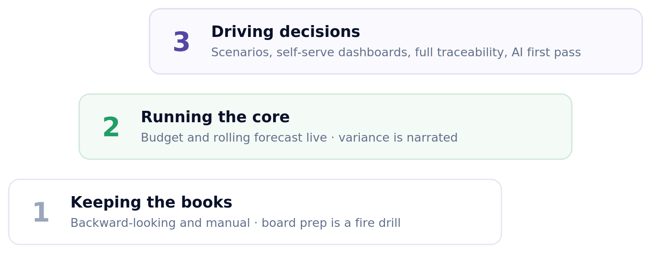 Tier 1, keeping the books: backward-looking and manual. Reports need heavy cleanup, board prep is a fire drill, and leadership waits on answers.
Tier 2, running the core: a budget and a rolling forecast are live, variance carries a narrative, and the board package is repeatable. Numbers refresh on a schedule instead of on a scramble.
Tier 3, driving decisions: scenario planning informs strategy, teams self-serve from dashboards, every number traces to the source, and AI drafts the first pass so your time goes to judgment.
You do not need to master everything at once. In your first week, put the ideas into practice with four small tasks that map directly to the sections above. Navigate a workbook and find an existing report. Pull an actual-versus-budget variance view. Take one number and drill it back to its source transaction, which will feel familiar. Then ask a plain-English question of your data and check the answer against the numbers. Note anything unclear as you go, because that is exactly what your CSM and the help resources are for.
The five things to remember
-
Accounting and FP&A are different jobs that share a foundation you already have. Your discipline transfers directly.
-
FP&A turns GL data into decisions leadership can act on. That connection is the whole job.
-
The right tooling keeps you spreadsheet-native while automating the heavy lifting. You keep the interface, you lose the busywork.
-
Every number you report can be traced back to its source. That is what earns trust, and what makes AI safe to use.
-
Move one tier at a time. You do not have to master everything at once.
Get the full field guide
From the Books to the Boardroom covers all of this in depth: eight chapters that take you from the close to the board deck, plus a maturity model and a first-ninety-days plan. It is free.