AI & Agents
Cube AI makes financial data decision-ready across every FP&A tool and workflow.
Learn more about AI at Cube →Meet the Agents
The Agentic Layer
The governed foundation — platform capabilities.
Consolidation & Close
The entire financial close and data management cycle, at a high level.
See all →Industries
Purpose-built for how each sector runs finance.
Evaluate
For buyers in-cycle.
Learn & Support
Guides, resources, and help.
Company
About Cube, careers, and news.
Customer Story
Primer's CFO runs FP&A solo. Cube is how.
Edgar Ejercito runs all of FP&A solo at Primer, across two entities, with no dedicated admin. He cut board prep from a week to half a day, and he trusts every number coming out of it.
Cube is the agentic FP&A platform that connects bi-directionally to Excel and Google Sheets and to source systems like NetSuite, giving finance teams trusted, decision-ready data without leaving their spreadsheets.
½ day
Board prep, was 1 week
2 hrs
Variance reporting, was 3 days
<1 min
Deck iteration, was hours
The setup
The Situation
When Edgar joined Primer two and a half years ago, he was rebuilding the finance function from scratch. Forecasting, budgeting, and board decks all ran out of a single sprawling Excel model. He knew it would not scale. He had used Essbase, Adaptive, and Planful before, so he understood what a capable FP&A platform could do, and he also knew what those tools demanded in return: a dedicated, trained admin.
That was not an option. The finance team was effectively him. Primer had since acquired a second company, adding a second entity to plan and report on, and it was all still just Edgar.
He evaluated multiple platforms and initially chose a different vendor in a bake-off. "That was a mistake," he said. He got out of the contract and came to Cube.
Company
Primer.ai, AI software, San Francisco
Company Size
51–200 employees
FP&A Team
1 person, the CFO
Entities
2, including 1 acquired company
Primary Use Case
Board reporting, forecasting, variance analysis
Stack Before Cube
50-tab Excel model · separate board forecast file · manual copy-paste
The Problem
Three days to explain a variance.
And still not sure it was right.
The model was not broken. It just could not tell you why something changed, and that made everything downstream harder.

Board prep took up to a week, every quarter
Bridging a quarter-over-quarter forecast meant cutting and pasting between separate Excel files, then hunting for why the numbers did not tie. Every iteration introduced new risk: an extra row, two cells pointing at the wrong column.

No fidelity to trace a variance back to its source
When you are copying and pasting numbers across months, you lose the thread. Variance explanations were built on memory rather than data. Edgar could not bridge a forecast quickly, and could not fully trust the bridge once he did.

Every other tool required an admin he didn't have
Planful, Adaptive and Essbase all required a dedicated, trained admin to manage the platform. For a one-person team rebuilding a finance function from the ground up, that was a dealbreaker he could not work around.
THE AGENTIC FINANCE LAYER
Finance in the driver's seat.
No admin required.
The Solution
Your spreadsheets stay. Everything underneath gets smarter.
Cube's patented bi-directional sync connects directly to Excel and Google Sheets, so there is no separate tool to learn and no data transfer to break.
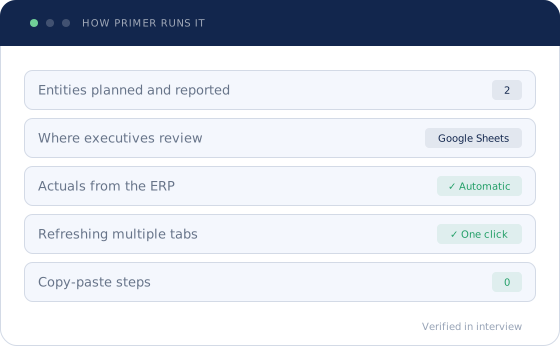
Edgar forecasts both of Primer's entities from one place.
Department heads and executives review budgets and actuals in Google Sheets, the tool they were already on. Select multiple tabs and refresh everything in a single click. Actuals flow in from the ERP automatically. No copy-paste, and no version drift.
Variance
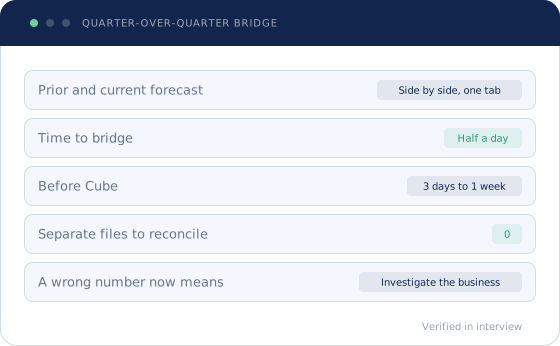
Bridge a forecast in half a day. Trust every number in it.
Edgar built a scenario tab that holds prior forecasts and current forecasts side by side. He bridges variances directly inside Cube, then drops the output into the board deck.
No separate files, no cross-referencing."If there's a number wrong, it's because it's something I should truly investigate," he said. "It's not an error in the model, it's a signal about the business."
Ownership
Modify your model yourself. No consultants. No tickets.
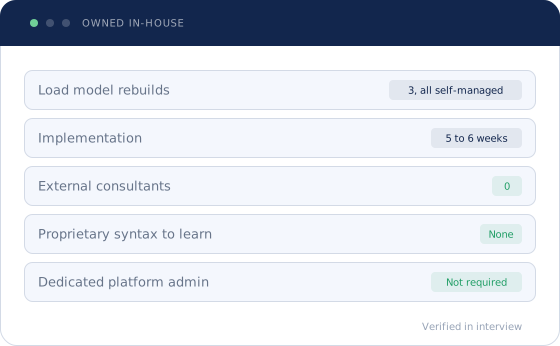
Edgar rebuilt his load models three times as Primer evolved: adding a second entity after an acquisition, rethinking how vendor dimensions were structured, and iterating on what made the forecast most readable. Every change happened in-house, with no implementation partner, no IT queue, and no proprietary syntax."
If you could have somebody like me running Cube, that means somebody much fresher out of college can do it much more quickly."
How It Happened
From a 50-tab Excel model to board-ready data in one implementation cycle.
Five to six weeks, self-managed, with no implementation partner and no dedicated admin on the other side of it.
1
2
3
The Results
When the data is right, the board conversations change.
½ day
Board forecast prep, down from a full week every quarter
2 hrs
Variance reporting, down from two to three days
<1 min
Board deck iterations, down from hours of copy-paste
0
Extra FP&A headcount hired. Cube let Edgar postpone the hire.
If there's a number wrong, it's because it's something I should truly investigate. I can identify issues with the business.
Edgar Ejercito
Chief Financial Officer, Primer.ai · San Francisco, CA
Common questions